

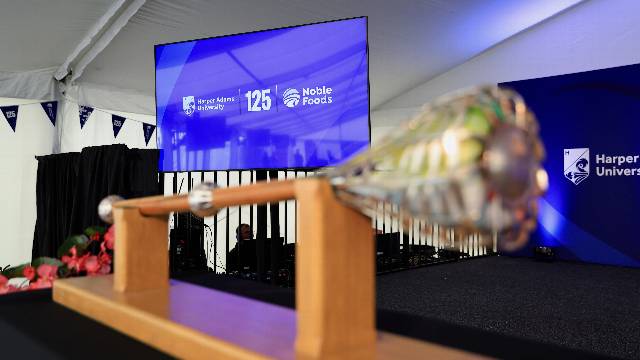
 Looking back at a remarkable 125th anniversary celebration
Ian Rowley is Harper Adams University's Executive Director for Institutional Impact and Engagement – and had a front-line seat as prep …
Posted 1 October
Looking back at a remarkable 125th anniversary celebration
Ian Rowley is Harper Adams University's Executive Director for Institutional Impact and Engagement – and had a front-line seat as prep …
Posted 1 October
Prospects for autonomous agriculture in Bangladesh focus of Harper Adams academics' article
15 March 2023

The possibilities for Bangladesh’s agriculture to be transformed through the use of autonomous agriculture have been explored by two Harper Adams academics.
AKM Abdullah Al-Amin, an Elizabeth Creak Fellow at Harper Adams University and Professor James Lowenberg-DeBoer, Elizabeth Creak Chair in Agri-Tech Applied Economics, have written for the Bangladesh Daily Star to examine the impact that using crop robots and other autonomous agriculture could have.
With Bangladesh setting a vision of sustainable, safe and profitable agriculture, the article explores how the use of such robots could tally neatly with the way most agriculture in the country is carried out.
It notes: “Agriculture in Bangladesh follows the typical pathways of agricultural transformation from partial-to-whole-farm conventional mechanisation. However, conventional mechanisation favours larger, roughly rectangular fields, requires sole cropping, and follows the ‘get big or get out’ principle. Indeed, sole cropping exacerbates soil health, climate change impacts, and in-field biodiversity challenges. Against this backdrop, Bangladesh needs sustainable intensification solutions for smallholders.
“In this situation, low-cost small autonomous machines – also known as crop robots – can be possible solutions. These machines, costing approximately the same as a motorcycle, could bring a paradigm shift in farming. Crop robots can increase the overall system efficiency even in small, irregularly shaped and fragmented parcels. For autonomous machines, there would be no special need for restructuring the rural landscape, nor removing the plot boundaries (ail), because crop robots can be programmed to work on predetermined paths in the existing fields.
“Autonomous on-farm and/or remote field operations could efficiently complete crop establishment, plant protection and harvesting, while reducing labour problems and attracting youth to farming.”
Related Posts
Looking back at a remarkable 125th anniversary celebration
Ian Rowley is Harper Adams University's Executive Director for Institutional Impact and Engagement – and had a front-line seat as prep …
Posted 1 October
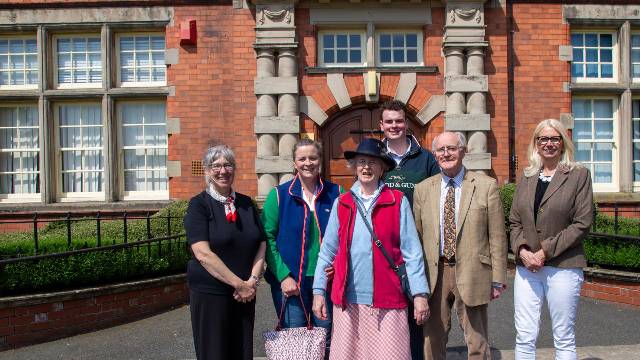 Iconic dog trainer Barbara Woodhouse's legacy lives on at Harper Adams through her great-grandson
For many, Barbara Woodhouse has been a household name over the years for her approach to training our beloved four-legged friends.The …
Posted 30 September
Iconic dog trainer Barbara Woodhouse's legacy lives on at Harper Adams through her great-grandson
For many, Barbara Woodhouse has been a household name over the years for her approach to training our beloved four-legged friends.The …
Posted 30 September
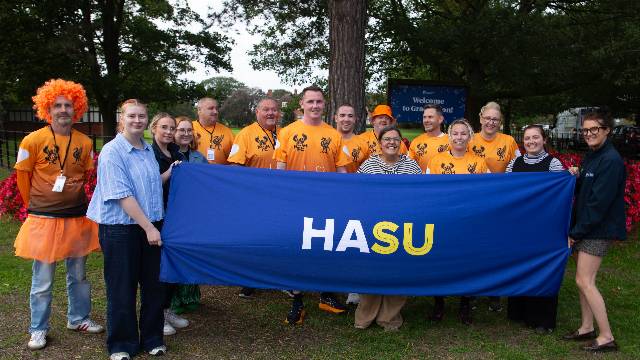 University welcomes awareness-raising meningitis B run
A runner who undertook a 100-mile challenge between two football stadiums to raise awareness of meningitis B has completed his trip.Sha …
Posted 22 September
University welcomes awareness-raising meningitis B run
A runner who undertook a 100-mile challenge between two football stadiums to raise awareness of meningitis B has completed his trip.Sha …
Posted 22 September
 Student Choice Awards 2026 celebrate the best in learning and teaching support
An annual awards ceremony to celebrate excellent learning and teaching support has been held at Harper Adams University.The awards are shape …
Posted 9 September
Student Choice Awards 2026 celebrate the best in learning and teaching support
An annual awards ceremony to celebrate excellent learning and teaching support has been held at Harper Adams University.The awards are shape …
Posted 9 September